Saturday, September 19, 2015

Post #3: Opportunism

Opportunism is something that all of us face every day. Sometimes the opportunity is big and sometimes small, but either way, if it is at somebody else’s expense, then it is best to consider the effects with empathy.

This is on ongoing story about opportunism so bear with me. A couple years ago, I needed to borrow a few hundred dollars. This is something I do not make a habit of, but without an income source at the time, I was running low on money. I decided I would have to bite the bullet. I did not have many people who would have given me anything, so naturally I began to stress out quite a bit over my financials. However, my sister was very generous with me. She loaned me the money when she saw that I was struggling. A few weeks later I was able to pay her back half the money I owed, but to this day, that second half needs to be paid back.

Now here is where opportunism comes into play. I do not think she remembers I still owe her. It is not a lot of money, and I don’t think she would miss it. She has always been good with money. As a college student, I’m just always a little short on money, so I will admit that it has not been priority or even possible. Nevertheless, I do intend on paying back the loan very soon.

There are several reasons why I have absolutely no desire to act on opportunity. First, somebody did something nice for me, and I would not take advantage of someone else’s generosity or kindness. Second, something like that sticks with you. I would not want to regret my actions for the rest of my life. Third, I always try to see these kinds of things from the other person’s perspective. If I loaned money, I would be really unhappy with someone if they failed to repay me. Lastly, in the long run, the money is of little value. It would be more detrimental over time to keep it and cause trouble than to give it back and be done with it.

All of these reasons are an issue of ethics and morality. Sure, nobody would know if I just kept the money. Whenever I am faced with such a situation, I like to think of it like this: if everyone made the same choice, would the world be better or worse off? If the answer is worse off, I do not do it. I always think that if I am not part of the solution, I am part of the problem.

I think empathy plays a large role in how people respond to opportunism. Those with more empathy are much less able to take advantage and to harm other people for personal gain. Others who do not have empathy will do just that. Many, but not all, of the “successful” people in the world got that way by acting on opportunism whenever it presented itself. For example, politicians are known to be some of the most corrupt people there are. It brings up constant consideration, whenever a politician makes a decision, if they are acting on opportunism or trying to help. As a result, even the good ones face scrutiny.


Opportunism is something that we see all the time and in all different shapes and forms. Some people will inevitably take advantage of opportunity and some people will not. It is all a matter of incentives. Depending on a person’s values, they may find personal gain to be a better incentive or they may find helping others to be a better incentive. It all just depends on the person. 

Friday, September 11, 2015

Post #2: Experience in Organizations

Back when I was in high school, I volunteered every summer for a camp known as National Youth Leadership Training (NYLT) which was primarily associated with the Boy Scouts of America. This week long course (two weeks for staff) turned complete strangers into an efficient organization so that they may gain experience in team-building and goal-setting for use in future situations. This teaching would come about in the form of both seminar-styled lectures, led by assigned junior and adult staff, and the practical application of the aforementioned lectures.

The organization was structured as follows:

The participants were randomly separated into groups of six or seven. For training purposes, a new leader was selected each day so that they may experience the position firsthand. With the position came responsibilities such as attending certain daily meetings, reporting on the progress of the team, and delegation to subordinates.

The next level up included the junior staff (which I belonged to) which had a hierarchy within itself. With the exception of the junior staff leader and the assistant junior staff leader, both of which were selected by the adult staff in advance, junior staff members were randomly paired with a team of participants. This person’s responsibility would be to monitor and guide the assigned team very closely at first but to become increasingly indirect as the teams became more effective. They would also act as intermediary between participants and higher-level staff.

The adult staff had limited power. Responsibilities mostly included guiding junior staff members, logistics and communications for the camp as a whole, and assisting in cases of emergency.

What governed all members of the camp was the guidelines set forth by the higher and higher levels of the national program which eventually reported to the Boy Scouts of America somewhere up the chain of command. These guidelines addressed what should be taught and performed by the staff essentially outlining the ideal way to operate.

That being said, the organization of this camp mostly included systems of monitoring and guiding from the staff members. As the week went on, and participants became more confident and competent, the power shifted more and more into their favor.

While we were required to adhere fairly closely to the NYLT guidelines, the success or failure of the program was ultimately based on the participants. The staff had to conduct seminars and activities and otherwise present the tools for success. Occasionally, they had to ensure certain things would get completed. Other than that, success could be defined by the participants. This was something they were unused to, yet they consistently outperformed expectations by the end of the week. Many would choose to come back for the next year and onwards as junior staff.

So why did this work? Governance. Without the hierarchy, policies, and guidelines, the camp would fail. Through monitoring, motivation, and intermediaries, participants stayed focused and on track. In other words, there were transaction costs. In this particular instance, the staff was intrinsically motivated. They volunteered and found joy in fulfilling these responsibilities. Nevertheless, this system required governance and, by extension, transaction costs. The Boy Scouts of America had to monitor the NYLT program. The NYLT program had to monitor each subordinate position within itself down to the level that monitors individual camps. Finally, we reach the hierarchy described above.

The bottom line is that it works in this situation. The transaction costs are enormous, but there is an enormous number of volunteers who find enjoyment in it. Not to say wages have never come up. If the program continues to grow faster than the volunteer count does, additional incentive may be required to fulfill responsibilities. To my knowledge, this is not yet the case.

Friday, September 4, 2015

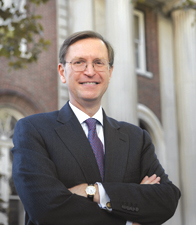
Glenn Hubbard Biography


Glenn Hubbard is a distinguished economist and current dean and Russell L. Carson Professor of Finance and Economics at Columbia Business School (CBS). His education includes a BA and BS which he obtained from the University of Central Florida in 1979 and an AM and PhD in economics from Harvard University which he earned in 1981 and 1983, respectively. Hubbard is also the co-director for the Richard Paul Richman Center for Business, Law, and Public Policy (2).

In addition, Hubbard has been chairman and co-chairman, both past and presently, of various councils, committees, clubs, and groups including the U.S. Council of Economic Advisors for which he acted as chairman from 2001 to 2003 (1). He has also applied his expertise to the U.S. government, serving as a consultant to the Federal Reserve Board and the Federal Reserve Bank of New York as well as deputy assistant of the U.S. Treasury Department (2).

Hubbard has written and co-written multiple books such as “The Aid Trap: Hard Truths about Ending Poverty,” “Balance: Why do great powers lose it? How can America regain it?” and “Healthy, Wealthy, and Wise: Five Steps to a Better Healthcare System.” He has also written and co-written several textbooks and over 100 articles on finance and economics (1).

Glenn Hubbard’s importance is a direct result of the work he has done in the fields of finance and economics. A combination of academia and government-related experience has allowed Hubbard to cultivate extensive knowledge that has since let him empower both students and government officials to make sound decisions and policies.

I was unaware of Glenn Hubbard before now. However, certain aspects of Hubbard’s career will be relevant to this class. For example, on the back cover of Hubbard and Anthony Patrick O’Brien’s book, titled “Economics,” it’s written that “The book motivates users by demonstrating how real business uses economics to make real decisions on a daily basis” (1). This feels very much aligned with what I expect to learn from the course material. Furthermore, Hubbard’s positions at CBS have him teaching business students and entrepreneurs (2). Regardless of opinions regarding Hubbard’s views on economics, business, and finance, his widespread knowledge and experience should be acknowledged.

As it so happens, rumor circulated that Hubbard had desire to be the chairman of the Federal Reserve. However, the position was given to Ben Bernanke. The following video was posted by MBA students at CBS as a result:

(1) http://glennhubbard.net/
(2) http://www8.gsb.columbia.edu/cbs-directory/detail/rgh1
(Image) http://glennhubbard.net/images/stories/hubbard.jpg
(Video) https://www.youtube.com/watch?v=ipJTqCbETog